Founders’ grip on control delays family wealth transfers, survey finds
A DBS study found that 43% of families had not brought the next generation into succession planning, despite ambitions to preserve wealth across generations.
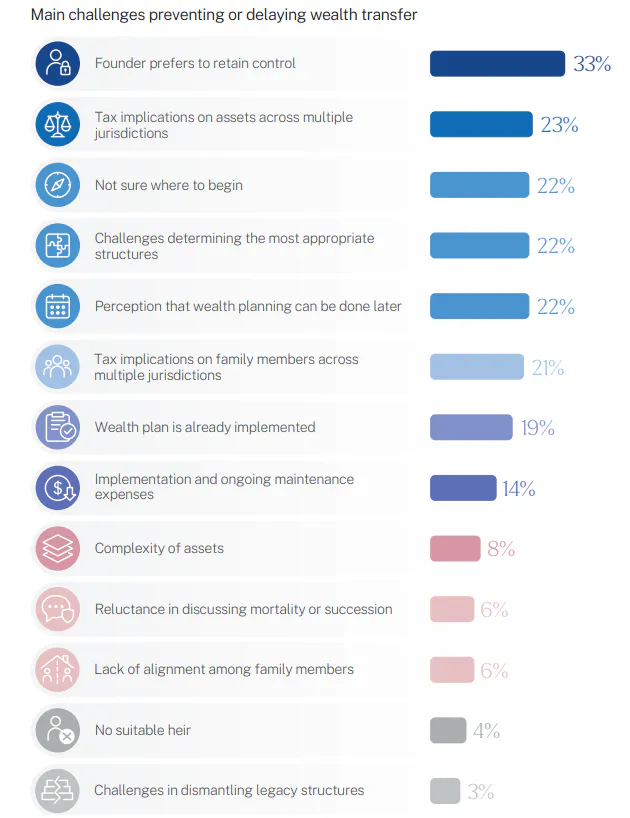
Founders’ unwillingness to surrender control is holding back wealth transfers, according to 33% of respondents in a DBS study. The DBS Asian Family Office Almanac 2026, published on 30 October, also identified shortcomings in succession arrangements, risk management and technology adoption.
The findings came from two surveys conducted between January and May 2026, covering more than 200 family offices in Asia, Europe and the Middle East. Although 79% of families wanted their wealth to survive for at least two generations, 43% had not included the next generation in planning. Only 1% had put that generation in charge of planning and implementation.
A significant transfer of wealth was expected within three years by just 4%, while 29% anticipated a wait exceeding seven years. Another 15% expected transfers only following a trigger such as a crisis or the founder’s death.
Ownership arrangements were another area of uncertainty. Key assets were held under personal names by 54% of respondents, compared with 20% using professionally administered trusts. Some 55% were undecided about which new ownership structures to choose, while cross-border tax implications were a transfer obstacle for 23%.
Formal business continuity arrangements were reported by only 15%, including 7% whose plans underwent regular testing or review. Cybersecurity and data privacy risks had not been addressed by 38%.
Interest in artificial intelligence outpaced adoption: 60% wanted to understand how to use it effectively, but 47% had not used digital tools or AI analytics in their operations. Respondents identified insufficient internal expertise at 49% and concerns about data security at 46% as the leading obstacles to broader adoption.